
Learning for Informal and Non-formal Educators in refugee settings in Lebanon and Jordan
The LINEs project, led by a team based at the University of Glasgow (School of Education) works with teachers involved in non-formal and informal refugee education in Lebanon and Jordan to explore their values, hopes and aspirations through participatory workshops. We also engage with the wider community, including children, carers and NGO representatives, to get their perspective on what this type of education is for and what it should look like.
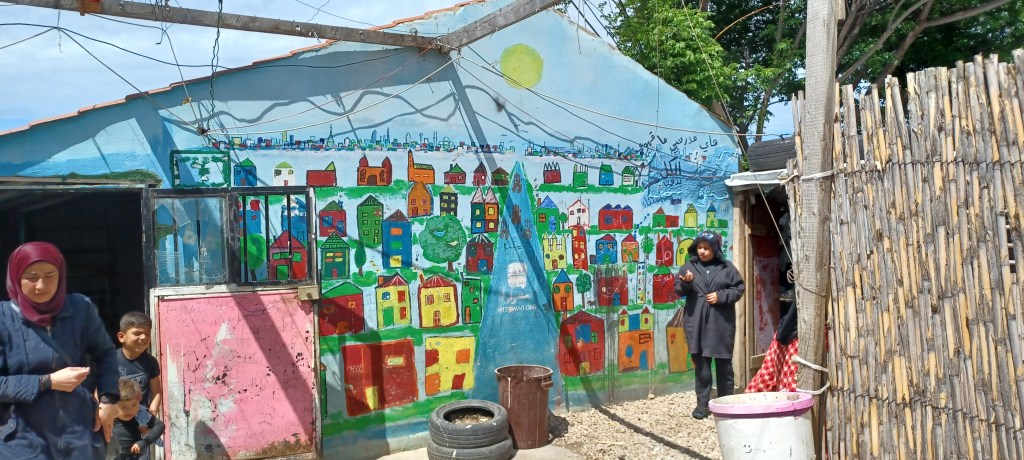
In Lebanon, with our local partner organisation, Mishwar, we supported teachers as they set up an educational programme to be delivered in 3 Syrian informal refugee settlements where most children do not have access to formal education. We worked with Mishwar and the teachers themselves to establish two new community schools, including sourcing and developing the spaces, and to re-start an existing school that had to pause activities because of lack of resources. The teachers will now provide Arabic literacy, numeracy, English, sports and arts.
In Jordan, we worked with Sawiyan, an organisation supporting newly arrived refugee communities. We heard from Sudanese, Somali and Yemeni refugee teachers, as well as non-refugee volunteers, about the values and principles which underpin the provision of pop-up, intergenerational English language teaching for newly arrived refugee communities. Anti-racist education and critical pedagogy ground the work of Sawiyan, and language teaching is key, as refugees are on the move and most hope to stay in Jordan only temporarily.
The project is funded internally by the University of Glasgow through the Glasgow Centre for International Development grants scheme

The LINEs project sites
Lebanon
In Lebanon, the devastating economic crisis, further exacerbated by the Port of Beirut explosion in August 2020, has had a dreadful impact on people’s daily lives. The devaluation of the currency, whose value has fallen by more than 95% in recent years, has pushed more than 80% of the Lebanese population into poverty. Lebanon is also home to 1.5 million Syrian refugees, and UN estimates that 9 out of 10 Syrian refugees live “in extreme poverty.” Against this backdrop, our partner Mishwar has had to prioritise basic needs, including securing food, medicine, and water. This has led to a disruption in the provision of their educational programmes. Our project funding and workshops with teachers provided an opportunity for Mishwar to resume its educational work, taking on board the perspectives of children, adults, and educators in determining educational priorities and visions.
Jordan
In Jordan, 760,000 refugees are currently officially registered with the UNHCR. Of these, 89% are from Syria. The majority (80%) of refugee in Jordan live in urban areas and host communities, not in refugee camps. In August 2022, UNHCR Jordan warned that securing funds from the international community was key to continuing to support refugees. Our partner Sawiyan has a long history of grassroots initiatives to support marginalised refugees in Jordan, particularly Sudanese, Yemenis, and Somalis. One of their main activities is the development of an English language teaching programme. In this context, the LINEs project explored language teacher identity and agency using the ‘tree of life’ approach, focusing on what it means to be a teacher in a context of protracted emergency and on the role that educators can play in this.

The importance of education
If our children can be happy and have a better future, we do not need anything else
― Syrian parent, Lebanon
Education is our way out, and that’s how we can fight for refugee rights
― Volunteer teacher, Jordan
Keen to get in touch?
If you would like to have more information on the LINEs project, if you have any questions, or if you are keen to get in touch for any reason, please feel free to write to us
 LINEs
LINEs 